Which Australian novels are really authentic ?
 ideaswithanne.com
 Some interesting observations
https://www.quora.com/What-novels-set-in-Australia-are-really-authentic-Which-are-not

https://japingkaaboriginalart.com/aboriginal-dreamtime-stories/
Dreamtime is a word that has been in language use for just over 120 years. In the English language it is now well embedded and well understood to represent something about beliefs in Aboriginal culture.
Perhaps it is an inadequate word because it tries to address a complex system of ideas that varies between different Aboriginal communities, and is very hard to express in an English word.
To some extent the idea of Spirit in Country along with the Laws that go with that Country, and the connections with the people who are born into that Country, are all reflected in the concept of Dreamtime. It may be that over the decades we have come to use it most commonly to mean the Creation stories from Aboriginal Australia. However it remains a term that we reach for when we see the powerful essence expressed in some of the significant Aboriginal paintings that we view in museums and art galleries.
It is a deeply complex term that carries a deep meaning for Aboriginal people, and this needs to be duly recognised in the wider Australian community.
The Dreamtime is a term that describes unique stories and beliefs owned and held by different Australian Aboriginal groups. The history of the Dreamtime word and its meanings says something about the development of the ideas held about the Aboriginal world, and how they are expressed through art.
Jukurrpa is one traditional term used by several groups of Central Desert languages to describe what could possibly be seen as the religion and the Laws of the people, and in some ways a description of Reality.
In that sense, traditional Aboriginal people believe that the world was created by Ancestor Beings. The spirit of the Ancestor Beings remains in the country, in the animals and the places and the people of that country as an ongoing presence.
Modern opinions on Manning Clark’s A History of Australia are mixed, with both strong praise and sharp criticism. While lauded for its literary style and contribution to shaping a national identity, it has been criticized for historical inaccuracies, subjective interpretations, and neglecting marginalized groups like Aboriginal people and women.
Here’s a more detailed look at the perspectives:
Praise:
Criticism:
In Conclusion:
Manning Clark’s A History of Australia remains a significant work, but its legacy is complex and contested. While it undeniably shaped Australian historical consciousness and is celebrated for its literary quality, it has also faced substantial criticism for historical inaccuracies, subjective interpretations, and its limited scope.
Manning Clark, Carl Bridge – Melbourne University Publishing
Manning Clark’s work provokes violent reactions for and against. His majestic six-volume A History of Australia ‘helped us to know who we are’. Yet attacks on C…

Melbourne University Publishing

On reading Mark McKenna’s biography of Manning Clark – Inside Story
25 Aug 2011 — Though Clark regretted the factual errors in his History, they alone don’t vitiate his broader intent, which was to write a history that would live a…

Inside Story

https://www.goodreads.com/book/show/59752203-making-australian-history
First review is worth a read
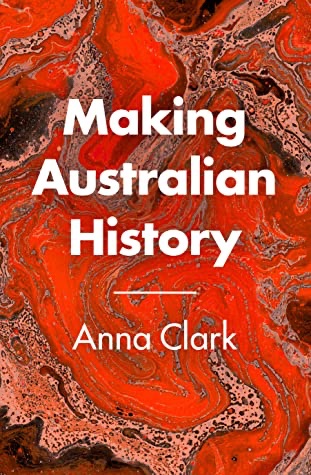
https://www.goodreads.com/book/show/59752203-making-australian-history
https://historicalragbag.com/2022/03/06/book-review-making-australian-history-by-anna-clark/
Why is this important? For this review it is essential. Making Australian History is about the history of History in Australia, how it has shaped our national identity, but also how History has been shaped.
Clark firmly positions the creation of Australian History at the same time as Australia was forming a national identity, but also at the time the study of History was being formalised and professionalised internationally.
This ‘scientific’ concept of History, where facts are immutable, personal opinion should not come into it, where History is unbiased, is at the core of the book.
Largely, the sidelining of non traditional sources including: oral history, First Nations history (through oral history and art work amongst other sources), family histories, local histories, non professional histories, fiction (including poetry), and other unwritten sources. By bringing these voices and sources back into the traditional view of History Clark makes the History richer, and explores how these alternative sources enable alternative voices to be heard.
First Nations art work, to convict songs, to photographs, to poetry, to fish traps. This is not say Clark excludes traditional sources with: speeches, early histories of Australia and other books also receiving the spotlight. Clark places these alternative sources on the same standing as traditional sources.
It is easy to see First Nations history as being suppressed completely once colonisation occurred, but Clark tells the story of its continuation as First Nations people continued to tell their own stories in many forms to advocate and fight for their rights. Their history is there, even in colonial sources, it is just often put aside by broader History.
Clark’s chronology follows History in Australia. She works from contact through to Federation (where the nation building drove a more blinkered version of Australia national identity that you see in the 1800s).
Continues through convict stories (as in the reality not the romanticised version) and their displacement as a ‘stain’.
Then through the White Australia policy and how History facilitated Australia’s national narrative as white.
On to protest (with an especially illuminating looks the the extremely constructed national History on display at the Australian sesquicentenary).
Along to The Great Australia Silence (the deliberate exclusion of First Nations people from Australia’s history).
Into family history (including her own- Clark is the granddaughter of Manning Clark) with a special focus on Judith Wright’s work.
Along to gender and women’s history, being both written into History but also looking at History overall from a domestic female lens. Continuing to emotion and ‘bias’ and the History Wars.
On to the importance of imagination in History, looking especially at Tony Birch’s poems that draw on the letters of First Nations people living on reserves.
Then examining Country, looking at the concept of ‘Country’ and whether it can be expressed in Western History but also the affect of landscape on History.
Concluding with time looking, at the concepts of deep time and how it supersedes modern Australian History by thousands of years.
Clark concludes with “our understanding and practices of History reflects values and beliefs at a point in time as much as it does any knowledge about historical time: histories shift and change with each iteration, according to their context, author and audience
https://www.abc.net.au/news/2025-06-28/bushranger-ned-kelly-glenrowan-siege-145th-anniversary/105442598
https://www.abc.net.au/news/2025-06-28/bushranger-ned-kelly-glenrowan-siege-145th-anniversary/105442598?utm_source=abc_news_app&utm_medium=content_shared&utm_campaign=abc_news_app&utm_content=safari